
Before continuing my seemingly endless exploration of the Evangelion franchise by discussing Evangelion: 3.0 You Can (Not) Redo (3.0), I feel like I need to clarify my closing segment in ny review for Evangelion: 2.0 You Can (Not) Advance (2.0). Which reminds me, a lot of what I’ll be writing here is predicated on my previous Evangelion reviews (basically all of them). While it is not necessary to go back and read all of them to understand what I’m discussing here, it definitely gives context as to how I feel about Evangelion, the Rebuild saga, and many other things. That said, let me talk about that 2.0 thing:
I wrote that what I liked about 2.0 was where it differentiated itself from the original material. It was different to see Rei inviting everyone over for a dinner party, which narratively is separate from the original material, yes, but also continues and investigates different aspects of characters we are already deeply familiar with. Additionally, it’s just good writing, interconnecting more dramatic lines and helping to culminate in deeper tragedy. That sort of differentiation is something that both reinterprets original material while also teaching us new things about it. What we want when material is continued is for it to continue the story. We don’t want it repeated. We don’t even want this in the span of a 90-minute movie. Why would I want this across 3 of them?

Which leads to why I feel 2.0 so mightily drops the ball. Its climax is essentially the same event as its show-counterpart: Shinji, piloting EVA Unit-01 causes the Eva to intake the equivalent of an S2 engine. Lore wise, this would mean the Eva no longer needs an umbilical cord to operate: it can function indefinitely, permanently forever without external needs. This makes EVA Unit-01 very dangerous in the show because it essentially means the Eva could operate destructively, with its own intention, without recourse to restrain it. Additionally, it could kick-start the events we see unfold in Neon Genesis Evangelion: The End of Evangelion (EoE) at any moment. Despite 2.0’s ending functioning a little differently, this is why I can comfortably argue that even though the stencil and color may be different, it’s still the same drawing. And, unlike the show, the movies are much shorter in total runtime and therefore the aforementioned science-fiction gobblydygook fills a higher percentage of the material. No amount of juxtaposed, dissonant kid-choir music can make gobblydygook worthwhile even if I would sob during these scenes some-7 years ago. Maybe I was just easily impressionable.
I felt the need to start my 3.0 review this way because I truly want to assert that I get it. I get Evangelion. I understand what’s happening in terms of its material. I am not sitting here saying the science-fiction is incomprehensible. Although I may assert it to make a point, one can easily understand the progression of events. The problem comes in whether those things actually matter, for which they don’t. As such, when it comes to 3.0 specifically, the movie functions under the same model of operations I had with 2.0: I like the new stuff, I really dislike the same-old stuff. Let’s get into it.
3.0 takes the bold move of starting 14-years after the events of the previous film. The film itself also left a lot of real-world time between itself and its predecessor. 2.0 was 2009. 3.0 is 2012. Shinji plays our audience stand-in, a figure who has no idea what’s going on and neither do we. It’s 14-years later but Shinji, Asuka, and Rei are all the same age (with Asuka’s plot reason being the absolute oddest, most poorly written excuse for her to remain a sensually pleasing… 14-year old?), the whole world has been covered in a red-colored sea, Misato is piloting the Evangelion’s equivalent of “White Base” from Mobile Suit Gundam, and that’s about all we really learn in this otherwise scant film.
In my opinion, the immediate lack of information given to the audience is the literal best decision this movie makes. Let the audience sit in the vibes. Let them soak up uncanny visuals. Let us be confused and curious, actually eager to learn new information. The extreme lack of characters spouting gobblydygook is a warm welcome to 3.0 and it makes so much of the film enjoyable. With the Earth’s population cut down to size yet again after another Impact there’s so much open, dead space for Shinji to curiously investigate, and the haunting atmosphere of an empty world, one we are all familiar with after watching and rewatching Evangelion material over and over and over; it really works here. Even Shinji’s interactions with Rei are totally solid, and I think it’s fair to say some of the best content the Rebuild’s have to offer is in these early segments.
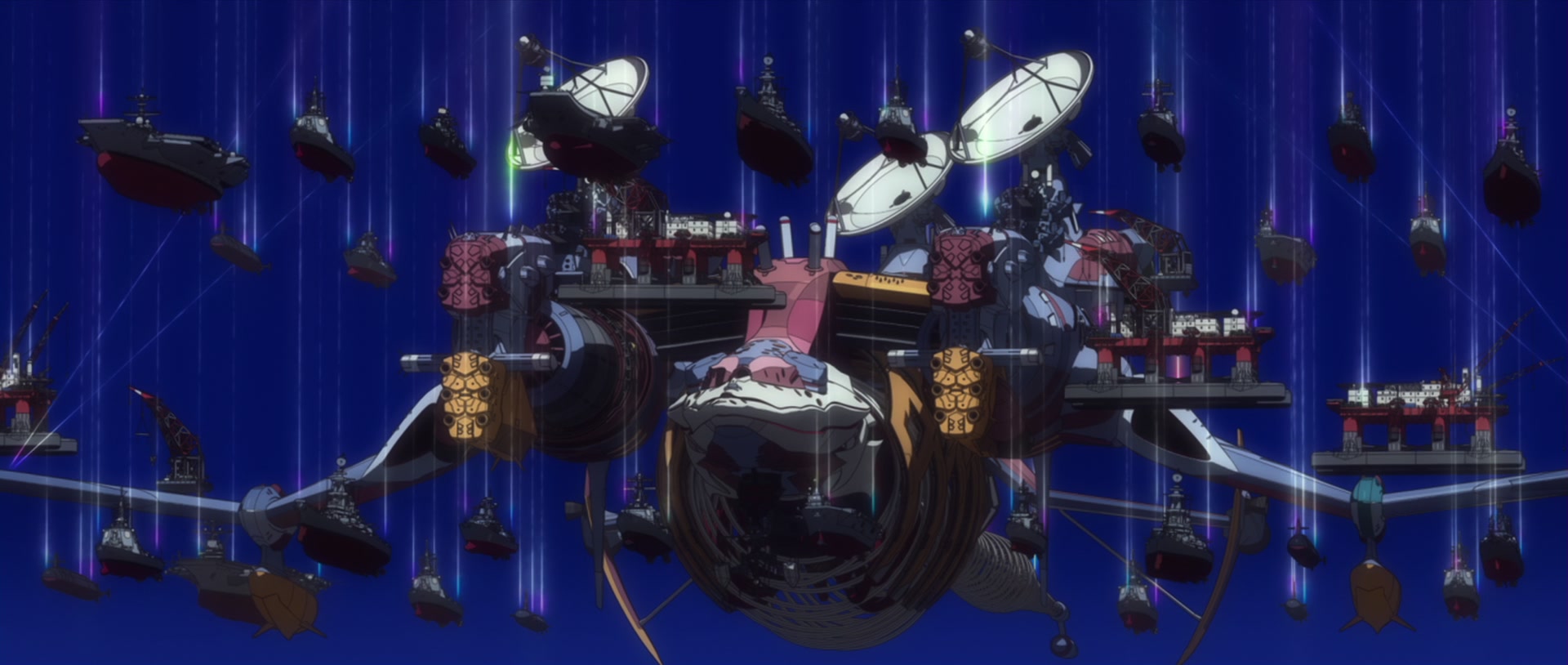
But, things are flimsy at best. The opening sequence is truly laughable. Although the opening if the film itself is inquisitive and really stunning in terms of animation, feeling like a live-action movie more than animated, it quickly devolves when Asuka and Mari are just flippin’ and flyin’ through space and there’s no sense of direction. Then, the next action sequence in which Misato pilots a fleet to basically knock some faux-angels into each other just to get a good shot? Really silly stuff. Anyone taking it seriously is off their rocker. There isn’t a lot of combat in 3.0 but every time it happens there’s something wrong.
The Kaworu material here is… Okay. It’s appreciative to see more of a character who is undoubtedly rich and memorable from the original show. Kaworu, a character with less than 14-minutes if screen time in a 20+ episode anime stands as one of its most important – and fiction’s most fascinating – characters. What he stands for and who he is to others is amazing to discuss, and it was a no brainer for 3.0 to explore this angle… at least in part. And, for the most part I do enjoy it. I like the piano lessons, the simplicity with-which he teaches Shinji to enjoy risk and creativity. I was even moved, and on the Rebuild’s wavelength, when he monologues about essentially what the Rebuilds are about: so long as you’re alive, there’s always opportunity to try again. In this way, we finally have something that really comments and continues themes from Neon Genesis Evangelion (NGE) and EoE, making both overt reference to the allusions that this is a direct continuation to EoE and also asserting where we’re headed as a franchise. What we then hope for is a gripping resolution to this concept that is now introduced. That, through extremely odd degrees of science-fiction, the events if NGE and EoE have been “repeated” and we’re going to say something deeper about this conversation, topic, and ideology.
But, this is where 3.0 begins to fall apart. Soon, Shinji laments a lack of knowledge, and rather than continue to let Shinji, and us, stew in this ignorance, Kaworu takes him somewhere to literally explain the plot. Kaworu, one of the greatest characters NGE has to offer, now has the task of being a lore repository: the gobblydygook has arrived. Even when I watched this one years ago I could almost feel the movie begging for this not to happen. It seemed so out of character for this film to actually explain anything, and from here on out everything is both over-explained and really stupid.
Now, when I say “fiction” I am talking about the story as a whole: the story itself, the story telling, and the experience of engaging the story. Immediately after Kaworu reveals the plot of the movie, the fiction of 3.0 turns wholly sour. Then, everyone just starts spouting gobblydygook again. Fuyutsuki has one of the dumbest scenes period, and then we get some really dumb action where nonstop gobblydygook is going on. Then, to make matters worse, the visuals go absolutely bonkers with bright lights and colors, and I can understand why people eat that up but it is just so over the top. This is a total regurgitation of EoE material in the worst way possible. Here, everything feels so digital and clinical. Sterile beauty feels cold, and the entire visual chaos at the end of 3.0 is like walking into a freshly cleaned post-modern, millennial-gray dentist’s waiting room. It’s just frigid, imperceptible, and takes forever for my appointment to start.

3.0 is doing EoE again but worse. Where EoE watches the entirety of Nerv wiped out in its first half, 3.0 already has Nerv removed. Where EoE watches the ridonkulous imagery unfold, 3.0 serves up cold coffee art. It’s counterfeit in every way and frustrates in even more. Being a movie like Evangelion: 1.0 You Are (Not) Alone or 2.0 at least plays it so safely that I never got as frustrated as I did with 3.0. Rather, 3.0 shows there is potential for more directions to be taken with Kaworu, Rei, and Shinji, but none of them are taken to their full extent. Honestly, all of these interests are better handled in the Manga, proposing an entirely different read on both Shinji and Kaworu (one that is equally as interesting as the show). But, 3.0 comes up extremely short in every department. It’s awkward, nonsensical, vapid, and irritating. We are following through with this concept of cycles, retrying things to “get it right” or “get it satisfactory” but… Why? Who asked for this? Is this just to satisfy contract? To satisfy corporate interest? Evangelion is an extremely valuable property in Japan after all. Is producing profitable material like this why we try and try again? NGE and EoE were already immensely valuable before the Rebuilds, both critically and financially, so it’s not like the ideology of doing the whole ordeal over again “but better” this time makes sense… right?
As for the ending… Well, years ago I wasn’t sure how to feel about this movie, and up until this rewatch I had flip-flopped many times (although now I’ll probably stick with a negative feeling). But, I always liked the ending. Like, the ending ending. It felt haunting, reminiscent of unfinished upcoming business. Everything was gone and all that was left was the original three, and I was always interested in seeing where things were headed. So, I guess we’ll see what I think when I watch Evangelion: 3.0+1.0 Thrice Upon a Time.
Want more Christian-influenced media coverage? Subscribe to the Cinematic Doctrine podcast on iTunes, Spotify, YouTube, or your favorite podcast app!

Consider supporting Cinematic Doctrine on Patreon! As a bonus, you can gain access to a once-a-month movie poll where you decide a movie we discuss on the podcast, early unedited episodes of the podcast, and merch!!
Melvin Benson is the Founder, Editor-In-Chief, and Lead Host of Cinematic Doctrine. Whether it’s a movie, show, game, comic, or novel, it doesn’t matter. As long as it’s rich, he’s ready and willing to give it a try! His hope is to see King Jesus glorified as far as the east is from the west!

Cinematic Doctrine is available on iTunes, Spotify, YouTube, and other major podcast apps.






 Cinematic Doctrine
Leave a comment