
I usually separate a lot of my commentary on Letterboxd and blog from my commentary in the Cinematic Doctrine podcast. However, I’m going to copy-paste my notes from my recording document into a blogpost as I feel it summarizes my thoughts in a manner that is digestible and legible. So, if you’ve already listened to our episode on Journey to Bethlehem, you’re already familiar with how I feel. If not… I still recommend listening to the episode because there’s a lot of other things we talk about. It’s hosted above or you can find it in any of your podcasting apps.
Last thing I’ll say before the notes kick in: although the production and performances in the film are functionally fine, you’ll read below that the whole ethic of the project is why I stand by my score. So, if the 1/10 rating I have listed on my Letterboxd review seems extreme, I think it will become clear upon finishing this read. Apologies for the length.
Anyways, here’s my notes:
General, Surface Thoughts (Or, An Attempt to Ignore My Primary Discomfort of Watching Not Only a Biopic-esque Story But Also a Fictionalized Biblical Adaptation):
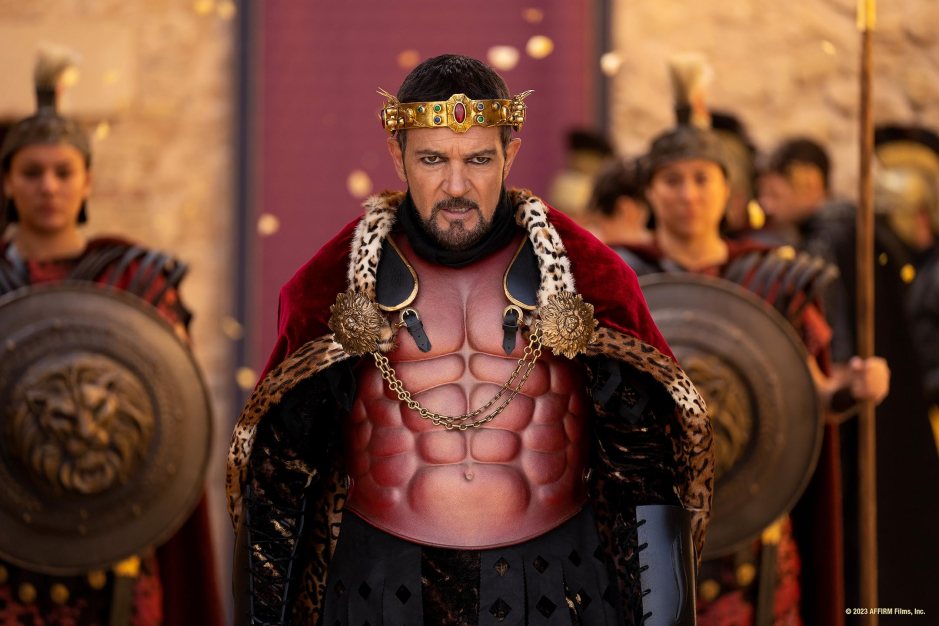
Not My Thing:
I like musicals. I like the Bible. I didn’t care much for Journey to Bethlehem. I don’t have a beef with Christian-Marketed material, although much of it is inherently questionable (in my opinion) as it profits off the good will of Christians, and it isn’t something I seek as entertainment. Same for CCM or Christian-Marketed music. Just not something I’m interested in. I think it’s important to start with this because it sets the groundwork for how I felt when I finally pressed play and started watching the film.
Fairly Forgettable:
I had initially prepped my notes roughly 24-hours after watching the movie. I remember key points that are obviously benefited by being part of the Scriptural story, but otherwise the whole of the experience has emotionally and mentally washed past me. I’m holding nearly zero feelings for the film both narratively, visually, and, like, just generally. I’ll remember that I’ve seen it – maybe – but I know my brain has already shredded any details or info apart from that to make room for other, likely equally as silly, things.
Polished (minor distraction):
Everyone’s complexion, eyebrows, and visual profile is immaculate. I’m positive people back then, Israelites especially, were fairly clean, but I don’t believe they would have had tweezers sitting around. Or Invisalign.
Musical Numbers:
Despite their characters largely being an irritation to me, the song Three Wise Guys was possibly my favorite song in the movie. Not enough that I’ll add it to playlists or ever listen to it again, but the song as a song is fairly complex and audibly engaging, changing styles and speeds and all that jazz. It also has contextual importance as characters continue to move forward the plot as they share information through their lyrics, and characters change or make decisions during the song that progress the story. Lastly, it understands the assignment of entertainment: to be entertaining. And I felt this song handled that best.

I start by celebrating this song because all the other songs were narrative walls. They brought the story to a complete stop. If each song was removed, nothing narratively would change. Here are three examples:
- Can We Make This Work: Mary and Joseph are conflicted about their arranged marriage. They already have shown conflict over their relationship, discussed it, and understand the confusion and drama of the situation. They then sing about their conflict, and then at the end of the song decide to move forward.
- The song doesn’t contain lyrics that explain their change in understanding one another. Its lyrics are merely about the conflict. If the song was removed, the same result would happen between these characters. They would express their conflict in dialogue, resolve to make it work, and move forward.
- Additionally, I know this story already. I already know they are going to work things out. So, why not make it interesting? Why not sing to me reasons why these two people would decide to work it out?
- The Ultimate Deception: Mary says an angel visited her and that she is with child despite still being virginal, and also that the child is the promised savior of the Israelites who is also the Son of God. Joseph is conflicted as to whether he believes this. They then sing about their conflict, and then at the end of the song decide to move forward.
- The song includes pointedly obvious visuals of Joseph’s internal conflict, which is okay, but then it becomes painfully and frustratingly obvious when he has lyrics that are literally: “Half of me believes her. Half of me doesn’t”. Meanwhile, we’ve watched as two halves dressed like Jedi spar in his dreams while accusing or defending Mary.
- Additionally, I know this story already. I already know they are going to work things out. And while the previous song I criticized could have some dramatic reasons as to why our characters come to terms with their scenario, here I’m not sure there’s much to change other than outright removing the song. Because, again, if the song was removed, we would already know the same information: Joseph is conflicted, but he’s leaning toward believing Mary.
- In My Blood: To prevent the birth of a prophesied Israelite king, King Herod suggests Antipater, his firstborn and right-hand leader (and also a legitimate historical figure), kill every pregnant woman and young boy. Mortified, Antipater suggests an alternative. Herod, irritated but complacent, then asserts vindictively, “Remember. My blood is in your veins. If you are to rule, you’ll have to be like me.”. Or something to that effect. Antipater then sing about their conflict, and then at the end of the song decide to move forward.
- Despite Joel Smallbone, the actor for Antipater, being possibly the best performer in the film (Antonio Banderas is hamming it up too much. Probably told to just be a Jack Sparrow clone), the song is still just another person singing about an internal conflict. There is no new information in this song, virtually no interesting visuals, and then he walks out… still conflicted.
All 3 of these songs could be removed, among others, and the plot wouldn’t change, the audience wouldn’t be lost, and everyone would be finished with the movie about 15 minutes earlier.
Constant, Deeper Thoughts (or, How Journey to Bethlehem Never Escapes the Uncanny Valley of Biopic-esque Scriptural Adaptations):

In the wildly popular film The Greatest Showman, PT Barnham invites singer Jenny Lind to tour the U.S.. Growing tired of Barnham’s shrewd business practices and marketing, Lind would eventually sever ties with Barnham and finish her tour without him. The film, however, decides to depict this professional schism as an interpersonal one, having Lind come on strong to a married Barnham, even kissing him publicly, which would later impact Barnham’s divorce to his wife Charity Hallet Barnham.
Imagine you had a professional relationship with someone that fell through. Then you lived long enough to see a movie adaptation of your life and it included that period. Now, to add drama, imagine the filmmakers depicted it as the response to a failed affair?
Fictional literature based on true events with real people have this problem where-in people become more familiar with the fiction than the reality. To further run with this example, let’s be real about this; not many people are going to go see one of the single most popular musicals of the last 10 years and then go home to fact check it, learn the real events of Barnham’s life and disposition, or even whether anyone in production has ulterior motives.
So, the end result is that a woman’s legacy is sullied and a man’s legacy is escalated (because he resists her advances) despite the reality being innocuous (or, at least, not recorded in detail). Worst of all, a discrepancy like this is often waved away because The Greatest Showman was popular 7 years ago. People have forgotten about it and this controversy already. Not to mention these people are dead, right? What’s the big deal?
No, it’s a big deal because this is how people are training their minds to think and observe the world around them.
Now, imagine all of this but with the Bible. Genesis to Revelation. A Pew Research study from February 26th, 2025 found that 33% of Americans report reading their Bible once a week. This is a book Christians read because we believe it is a written compilation of what God has spoken about Himself, His Creation, and His Redemptive Plan. We believe God has spoken, and the Protestant Christian Bible contains a record of those words. And we believe that salvation only comes through the hearing of the Word, and we receive the Word through the Scriptures!
33% of people read their Bibles once a week. A far higher percentage of people eat three meals a day in America. Yet Jesus calls himself the Bread of Life in John 6. He then later prays in The Lord’s Prayer, “Give us this day our daily bread.” (Matthew 6:9-13). Then, in Luke 24, after Jesus’ resurrection, he disguises Himself and walks with a disciple. The Disciple shares about how Jesus, a man for whom they all thought was the promised savior of Israel, had just been crucified 3 days earlier. Then Jesus responds in Luke 24:25-27: [25] “He said to them, “How foolish you are, and how slow to believe all that the prophets have spoken! [26] Did not the Messiah have to suffer these things and then enter his glory?” [27] And beginning with Moses and all the Prophets, he explained to them what was said in all the Scriptures concerning himself.”. So, the whole of Scripture is profitable as sustenance for ourselves.
Why do we eat? We eat because it sustains our body. The nutrients and proteins provide energy for our body and mind. Without it, we are woefully ill equipped for even simple tasks, moving about our days with fatigue and headaches. Just ask any fans of girl-dinner.
Americans are spiritually malnourished, with only 33% of Americans feeding on the bread of life once a week. The longest I have fasted was 6 days, and it gets brutal after day 3. The fatigue and the aches are nearly unending, and the second-worst period of sleep I’ve ever had was during the latter few days of that fast.
…And my savior is comparing Himself and all He encompasses to food? May the Lord convict us of our obstinate schedules. We must make time to feed upon Word. To spend time with our Maker. To get to know our Greatest Love.
I’m sure that significantly less than 33% of Americans have watched Journey to Bethlehem. Even so, let’s imagine that every American watched Journey to Bethlehem, a film that bookends by saying first it’s based on a true story and then afterward with “some creative liberties were had but maintaining the story took priority” or whatever. 67% of those who watched the movie will have, say, a cursory knowledge of the Nativity story, stepping away from the film possibly entertained but also feeling more enlightened to the story.
33% of people who read their Bible once a week will likely be able to tell you that the birth of Jesus is only covered in 2 of the 4 Gospel, but maybe not which ones.
But, what I’m most curious about is this: what’s the percentage of people who would be able to breakdown any discrepancies between Journey to Bethlehem and it’s source material? Obvious characteristics like the Wise Men being goofballs is easy to understand as fiction, but what about Mary’s disposition toward her marriage to Joseph, something the scriptures don’t specifically cover? What about her character as a faithful woman, one who receives the words of Gabriel with more tact and faith than Zechariah, her relative, who is also a Levite priest?
And yes, Deuteronomy 22:20-21 does talk about how if a woman betrothed to a man is found not to be a virgin, she would be stoned in front of her father’s home. Knowing this, Matthew 1:18-19 describes that “because Joseph was a righteous man…” Joseph quietly planned to divorce Mary. Some may wonder how it’s righteous for Joseph to not fulfill the law and have Mary stoned for what is perceived to be sin, (as she is with child before ever being married), yet Joseph does not bring a charge against Mary, which then means no legal proceeding to investigate the legitimacy of her story would take place. We then understand from what perspective Joseph is coming from, and why the text calls him righteous. Joseph may have believed that Mary sinned against him by committing adultery, but he forgives her, seeking to gently let the wedding go. He sacrifices his right to the law and finds an amicable way to preserve her life without shame, where shame ought to be (if she had indeed committed an affair). And yet even after he has set his mind on what to do, the next verse tells us an angel appears to Joseph in a dream to confirm what Mary has stated: she bears the Son of Man.
What I just did is investigate, discern, and extrapolate the scriptures. Here we learned of Joseph’s righteousness, the depths to which his forgiveness reaches. And, it also showcases the intrigue as to why an angel appeared to Mary first but not to Joseph until after he had made a decision about the pregnancy. Perhaps the Lord wanted to affirm Joseph’s righteousness for Mary’s sake? Who can say. All we have is the text, the order it is shared in, and the context within it presides.

Let Me Wrap Up My Point:
What is more comforting to the reader of the Scriptures? A lover of God? Is it what is explored in Journey to Bethlehem, or the Scriptures themselves? Often, fiction replaces reality. Fictional adaptations of the scriptures replace the scriptures themselves. People ponder depictions of scripture more than the scriptures themselves. People may be moved by Antipatar’s conflicted journey as King Herod’s firstborn son, perhaps engaging it on a spiritual level solely because this is a Christian-Marketed movie. and yes, Antipatar was a real man, a real firstborn son to King Herod. And yes, it is suspected Antipatar had disagreements with King Herod, as he was even tried under the belief that he intended to murder his father (and later executed for it).
But, the scriptures themselves do not have this whole character arc where-in Antipatar is conflicted over his father’s reign, nor meets Jesus during a tense climax.
Man is already prone to idol-worship. Prone to taking God off his throne and putting anything else there. Is it so foolish of me to find it worrisome that many take the Word of God from its position if importance and replace it with Christian-Marketed material? Christian music, Christian movies, Christian clothing, Christian lingo, Christian literature, Christian art, etc..
I could never stop thinking of all of these things while watching Journey to Bethlehem. I could never stop thinking about this. What space does Journey to Bethlehem occupy in the Christian’s mind? Has it altered their understanding of the Scriptural passages detailing the birth of Christ?
God willing, Joseph and Mary are still alive. And we KNOW Jesus is still alive as the firstborn of the redeemed. Would Joseph like how he’s depicted? Would Mary be pleased with how they depict her family? What does Jesus think of this?
These are questions that I don’t think will have good answers. I just don’t know what they would be. But everything I’ve said creates this cloud of spiritual discomfort, and I have no interest in entertaining it.
Want more Christian-influenced media coverage? Subscribe to the Cinematic Doctrine podcast on iTunes, Spotify, YouTube, or your favorite podcast app!

Consider supporting Cinematic Doctrine on Patreon! As a bonus, you can gain access to a once-a-month movie poll where you decide a movie we discuss on the podcast, early unedited episodes of the podcast, and merch!!
Melvin Benson is the Founder, Editor-In-Chief, and Lead Host of Cinematic Doctrine. Whether it’s a movie, show, game, comic, or novel, it doesn’t matter. As long as it’s rich, he’s ready and willing to give it a try! His hope is to see King Jesus glorified as far as the east is from the west!

Cinematic Doctrine is available on iTunes, Spotify, YouTube, and other major podcast apps.






 Cinematic Doctrine
Leave a comment