
It may have been a couple of years since I last rewatched Neon Genesis Evangelion: The End of Evangelion (EoE), but it’s fair to say this film has engrained itself thoroughly into my brain. It’s rooted, sprouted, budded, bloomed, pollinated, and produced wonderful fruit. It’s violently unapologetic attitude about itself and others is intensely honest in ways I can only perceive as positive even though I can understand and agree with others who think otherwise. EoE is ruthless in what it has to say, not only about its own material but also about the world it exhibits: the real world, that is.
EoE comes about a year and a half after the finale of Neon Genesis Evangelion, and while the Director’s Cut ending of the original show does include some imagery that is included in the film (specifically, a stinger detailing upcoming events. More specifically, it details Asuka’s return and subsequent fight with the finished Evangelion series), EoE really can only be considered an original materialization of what was originally planned for the actual end of Neon Genesis Evangelion. EoE combines the latter bits of Death & Rebirth, a condensed re-edit of the show combined with a new segment reimaging episode 24, with a completely new episode 25. For some who are confused as to why the credits for the film happen abruptly in the middle, this is why. Although, like most borderline incidental decisions made with the original NGE material (1995-1997), the credits remaining in the middle during EoE only improve the ending, increasing the foreboding sense of grotesque, hard acceptance of reality. The black emptiness of a finished movie, specifically on a screen nowadays, has the quality of reflecting one’s self – a black mirror – and confronts the audience one last time before they get up to do whatever else it is they do. It also asserts a serious assertion of finality. This is the end of NGE. There is no more material. Get up, toss your popcorn in the trash, and drive home.
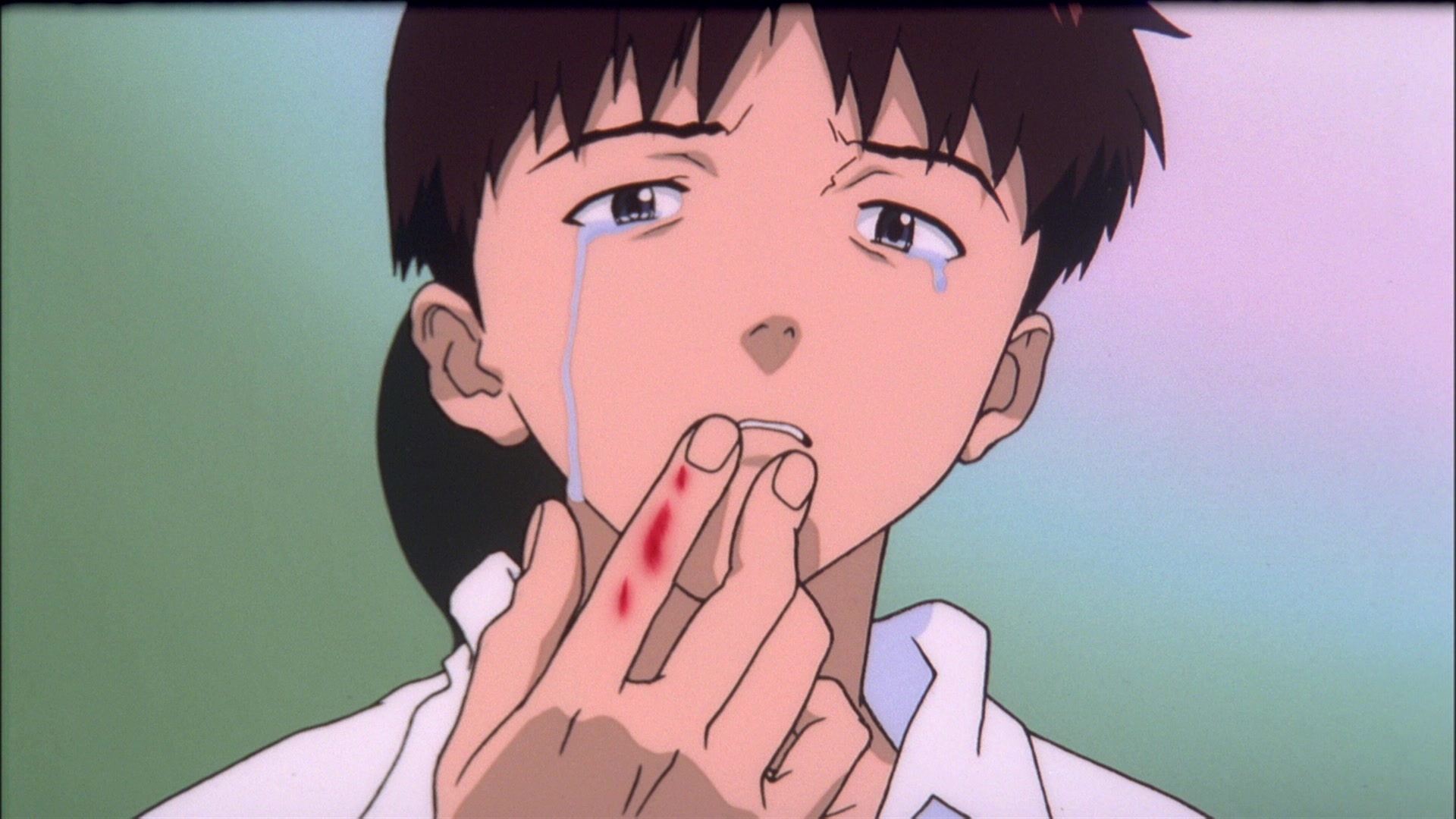
The team behind NGE no doubt was eager to leave the project behind them, insofar as they also recognized it as an important piece of media they had produced. I don’t want to presume to know what their experience was like, nor use what I would assume just to write something faux-profound. I’m sure no one on the team will ever read this, but the idea that one could read this and go, “that’s not true.” isn’t something I’m afraid of. I would just think I’m being irresponsible. But, with how much effort is put into EoE as a project – stellar animation, shocking imagery, terrifying voice work, climactic music – EoE feels like a swan song, a beautiful moment that is made more beautiful in its momentary, unchanging nature. In that way, the swan’s song is made beautiful in its memory, not necessarily in its singing.
EoE is a final project, but the irony is also that it is media. It can not only be watched but rewatched, as I’ve already attested. If I’m not mistaken, I’ve seen EoE a rough 7 times (as per MyAnimeList). It’s final, but its visitable. I can return to EoE whenever I want (I even have a DVD on my shelf). It will never change, even if what I see changes. But, what that asserts is that I’ve changed, and I think that’s a healthier way to enjoy the movie. As I change, I enjoy the movie more and more. And, if I change, I may dislike the movie, too. If that happens, I don’t think I’d change my score, either.
In my Neon Genesis Evangelion review I assert, in short, that the show is about the necessity to accept one’s inevitable need to grow. I also explored something similar in my Puella Magi Madoka Magica: the Movie III: Rebellion review, that ultimately the antagonistic force is recognized as the unequivocal inability to accept reality, and that by doing so one deludes themself into a fantasy world that is incompatible with reality, which then eventually leads to one’s own self-induced demise. In Rebellion the story is not over, so the extreme ending that continues the exploration of such denial of reality is simultaneously discouraging for some yet brilliant to others. I routinely fluctuate on both, because I find I lean discouraged when I think of the story as a fiction – a collection of characters I love and enjoy and want to see succeed – and thus buy into the fiction – the unreality of the story – as a fan. I then lean towards brilliant when I meditate on the films themes, denial of what fans may want deep down (including myself) and gentle-yet-forced display of what actually is.
While Rebellion is a story about literal rebellion of reality, NGE embraces a more surrealist, early Freudian ideology. It’s narrative routinely evokes early childhood development theories. A person is created and is one with their mother, united internally and wholly sustained: safe. Then it is expelled and is now solely dependent upon others, and first it learns who the “other” is in the mother. An infant’s eyes can only see about 1-2 feet anyway, which is perfectly suited for the distance from breast-to-face when nursing. The child learns two things: dependent on other. It is wholly indebted to someone else for life. Later, as the child grows, the phrase expands: I’m dependent on others. Unfortunately, it is entirely more difficult to define what “I” is in that sentence, where as we can easily explain all of the other words in that sentence, how they relate, etc. As each character in the show wrestles to understand who they are (think on the question Shinji routinely asks: “Why do you pilot Eva?”), they are also still trying to comprehend who they are in relation to their communal dependence. No one can live alone, and nobody truly wants to live alone, either. But, it is hard to coexist when one does not know themselves.
The Instrumentality Project will remove the “I” in “I’m dependent on others” to such extremes that it will deny any sense of self, nor one’s place in the world, simply so that it can be at peace. When Shinji is confronted with the question about whether he truly deserves the be where he is (that is to say, does he have a right to exist at all), his dramatic response is only reasonable as a 14-year-old. Teens are in a heightened state of ever-increasing individuality, and they are at a place developmentally where they can accept their growing responsibility or deny it. But, what they can never do is return to an earlier state of being: to nursing. It’s impossible, socially unacceptable, and biologically useless. It’s absurdity is put on full display in EoE as we’re assaulted by beautifully chaotic iconography, and one’s sense of self is made ever-smaller as we’re continually greeted by awe-inspiring visual after awe-inspiring visually. But, what is ultimately pursued – a return to the perceived safety of the womb – is easily understood to be a fallacy, and soon we are confronted with one of the most discussed endings in film history.
During a dream sequence we’re greeted to visuals of the real world. Gainax studio graffitied, hatemail (staged to summarize legitimate hatemail received), but most curiously is a panning shot if a real-world theater containing fans of NGE. In the front row is someone with two Fumo-looking plushes of Asuka and Rei. Another has the hair-clips for Plug suits. These audience members are fans who had seen Death & Rebirth during its theatrical run. Moments later, the audience would fade away and their seats would be empty.

There’s no denying EoE’s criticism of otaku culture. It’s prevalent throughout the series, so there’s no doubt the movie itself would continue this theme. EoE comes across abrasive and aggressive, yes, but it feels more disciplinary than hateful. It points out the importance and necessity of maturation and independence, two things otaku culture is not known for. Otaku culture has no identity and is dependent on its interests. Its identity changes with its interests, and it’s identity wanes when its interests fade away. It also never matures because media never changes. As I’ve said, my opinion on EoE will change as I change, but EoE will never change. Otaku culture, likewise, devotes itself to material that never changes, which is an absurd devotion for one who perpetually changes.
Humans are perpetually changing. Their dependence is constant, but their independence changes as they mature. One’s resilience is embodied in their independence, and I feel EoE asserts a joy in independence. Joy is not always a state of happiness but it is rooted in promise, and while the end of EoE is anything but happy, it is definitely joyful. Characters have matured, independence has been accepted, and now the dependence upon one another is finally being understood in a state of coexistence. And yet, Shinji – a newborn baby, crying, defiant of reality, suffering under existence – exists in both the kind gesture of Asuka (a gentle brush of the hand) as well as the immediate separation (“Disgusting.”) because this is what reality looks like right now. It’s awe-strikingly difficult, but its real, and now true operation can begin, because before there was nothing. Now, there is everything.
Want more Christian-influenced media coverage? Subscribe to the Cinematic Doctrine podcast on iTunes, Spotify, YouTube, or your favorite podcast app!

Consider supporting Cinematic Doctrine on Patreon! As a bonus, you can gain access to a once-a-month movie poll where you decide a movie we discuss on the podcast, early unedited episodes of the podcast, and merch!!
Melvin Benson is the Founder, Editor-In-Chief, and Lead Host of Cinematic Doctrine. Whether it’s a movie, show, game, comic, or novel, it doesn’t matter. As long as it’s rich, he’s ready and willing to give it a try! His hope is to see King Jesus glorified as far as the east is from the west!

Cinematic Doctrine is available on iTunes, Spotify, YouTube, and other major podcast apps.





 Cinematic Doctrine
Leave a reply to Evangelion 2.22 You Can (Not) Advance: Seeds of Gobbledygook – Cinematic Doctrine Cancel reply